Leave a Message

Thank you for your message. We will be in touch with you shortly.

What Happens to Housing when There’s a Recession?
What Happens to Housing when There’s a Recession?
Since the 2008 housing bubble burst, the word recession strikes a stronger emotional chord than it ever did before. And while there’s some debate around whether we’re officially in a recession right now, the good news is experts say a recession today would likely be mild and the economy would rebound quickly. As the 2022 CEO Outlook from KPMG says:
 
“Global CEOs see a ‘mild and short’ recession, yet optimistic about global economy over 3-year horizon . . .
 
 More than 8 out of 10 anticipate a recession over the next 12 months, with more than half expecting it to be mild and short.”
 
To add to that sentiment, housing is typically one of the first sectors to rebound during a slowdown. As Ali Wolf, Chief Economist at Zondaexplains:
 
“Housing is traditionally one of the first sectors to slow as the economy shifts but is also one of the first to rebound.”
 
Part of that rebound is tied to what has historically happened to mortgage rates during recessions. Here’s a look back at rates during previous economic slowdowns to help put your mind at ease.
 
Mortgage Rates Typically Fall During Recessions
 
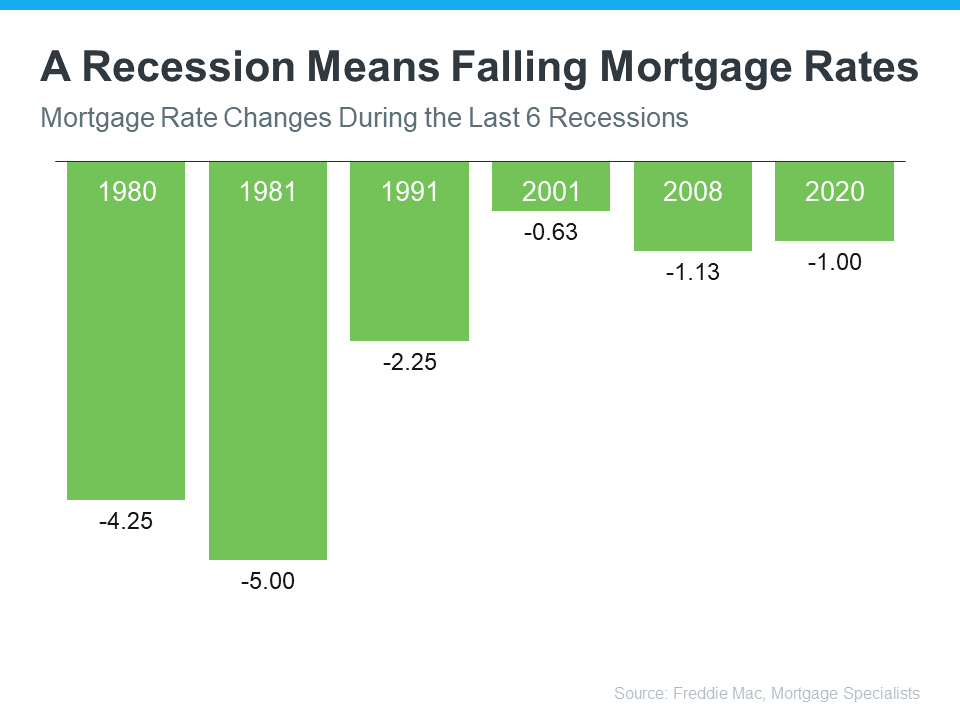
Historical data helps paint the picture of how a recession could impact the cost of financing a home. Looking at recessions in this country going all the way back to 1980, the graph below shows each time the economy slowed down mortgage rates decreased.
 
What Happens to Housing when There’s a Recession? | MyKCM
 
Fortune explains mortgage rates typically fall during an economic slowdown:
 
Over the past five recessions, mortgage rates have fallen an average of 1.8 percentage points from the peak seen during the recession to the trough. And in many cases, they continued to fall after the fact as it takes some time to turn things around even when the recession is technically over.”
 
While history doesn’t always repeat itself, we can learn from and find comfort in the trends of what’s happened in the past. If you’re thinking about buying or selling a home, you can make the best decision by working with a trusted real estate professional. That way you have expert advice on what a recession could mean for the housing market.
 

Bottom Line

 
History shows you don’t need to fear the word recession when it comes to the housing market. If you have questions about what’s happening today, let’s connect so you have expert advice and insights you can trust.

Recent Blog Posts

Stay up to date on the latest real estate trends.

SF Market Update - February 2026

Single-family home prices surged by more than 16% year-over-year, marking one of the strongest January performances in recent memory.

East Bay Market Update - February 2026

Single-family home prices posted modest year-over-year gains across both counties, while the condo market continued to slide with double-digit declines in Contra Costa… Read more

SF Market Update - January 2026

The San Francisco housing market closed out 2025 with impressive year-over-year gains in median sale prices. Single-family homes saw an 8.63% increase, with the median… Read more

East Bay Market Update - January 2026

As we moved through the holiday season, inventory levels dropped significantly across the East Bay.

SF Market Update - November 2025

The single-family home market is on fire in San Francisco right now, as the median sale price for a single-family home is reaching the highest level it’s reached in th… Read more

East Bay Market Update - November 2025

It’ll be important to pay attention to how this market evolves over the seasonally slow winter months, as dwindling inventories might drive prices up over time.

SF Market Update - October 2025

Last month we saw a big upward swing in median sale prices for single-family homes in San Francisco.

East Bay Market Update - October 2025

Listings are spending a lot more time on the market than they were last year, with single-family listings spending more than 20% longer on the market.

SF Market Update - August 2025

While much of the Bay Area is experiencing inventory issues, the vast majority of areas are seeing inventories begin to pile up. As we know, San Francisco has the oppo… Read more

Let’s Talk

You’ve got questions and we can’t wait to answer them.