Leave a Message

Thank you for your message. We will be in touch with you shortly.

SF Market Update - January 2025

SF Market Update - January 2025

The Big Story

Elevated rates are here to stay

Quick Take:

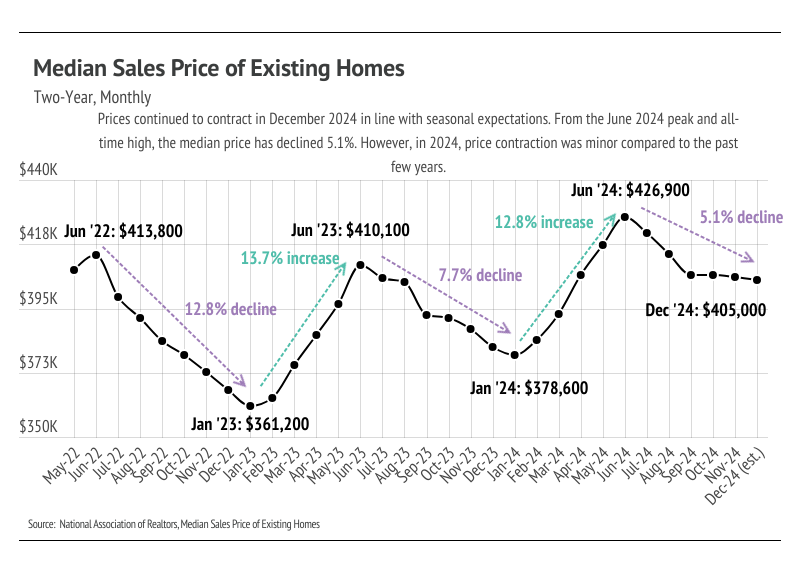
  • Home prices declined modestly in Q4 2024, showing atypical price stability in the second half of the year. Because prices didn’t contract significantly in the second half of 2024, they will easily rise to new highs in 2025.
  • Since September 2024, the Fed has cut rates by 1%, bringing the interest rate that banks charge each other for short-term loans to a range of 4.25% to 4.5%. In 2025, we only expect the federal funds rate to decline by another 25 to 50 bps.
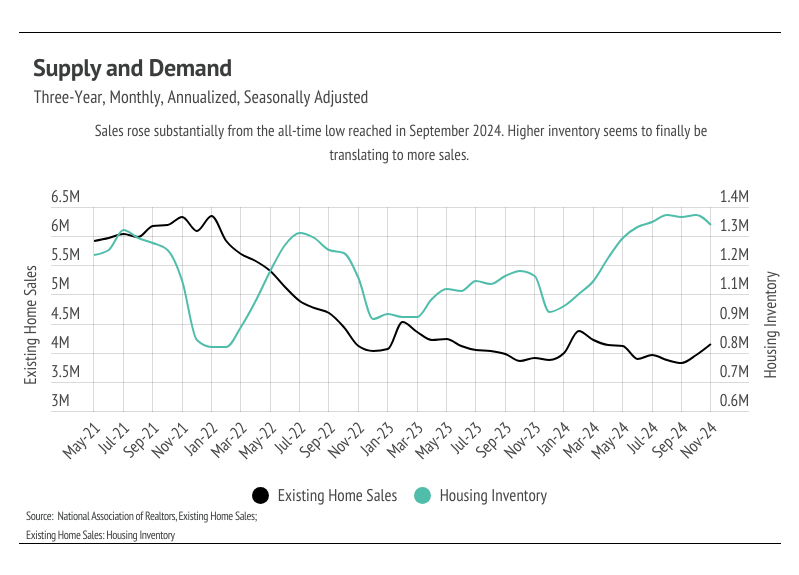
  • Sales rose 4.8% month over month, the swiftest pace since March. Sales accelerated 6.1% from one year ago, the largest year-over-year gain since June 2021. At the same time, inventory fell 2.9% but is still near its highest level in the past four years. Higher inventory levels created more opportunity for sales.
Note: You can find the charts & graphs for the Big Story at the end of the following section.
*National Association of REALTORS® data is released two months behind, so we estimate the most recent month’s data when possible and appropriate.
 

Economic (policy) uncertainty elevated mortgage rates

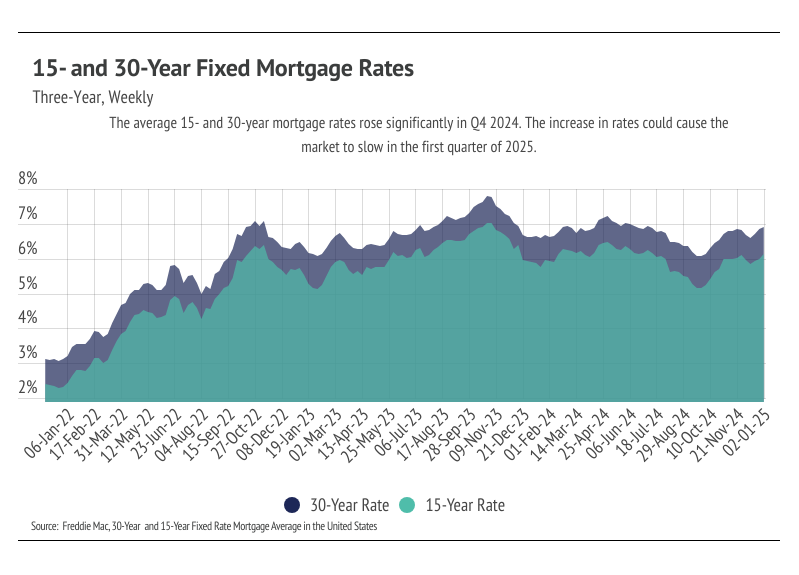
The Federal Reserve’s interest rate cuts in 2024 provided some relief to some borrowers, but mortgage rates have remained stubbornly high. As of January 2, 2025, the average 30-year fixed-rate mortgage climbed to 6.91%, its highest level in nearly six months, according to Freddie Mac. Even with the Fed lowering the federal funds rate by a full percentage point over the past four months, mortgage rates have not fallen proportionally, remaining about 0.3 percentage points higher than their 6.6% average in January 2024.
 
This disconnect is largely due to factors beyond the Fed's control, such as economic growth, inflation concerns, and fluctuations in the 10-year Treasury bond yield, which heavily influence mortgage rates. Economists predict that meaningful relief for homebuyers is unlikely in 2025, with rates expected to remain elevated between 6% and 7%. Lawrence Yun, chief economist at the National Association of Realtors, forecasts the average 30-year fixed mortgage rate will hover around 6.5% throughout the year.
 
Adding to the uncertainty, President-elect Donald Trump's proposed economic policies — potentially including sweeping tariffs on foreign goods and additional tax cuts — could reignite inflation. If inflation accelerates, the Fed will almost certainly curtail rate cuts. However, some analysts suggest Trump's tariff threats may be strategic bargaining tools in trade negotiations rather than definitive actions. If inflation continues to ease, the Fed could maintain its trajectory of lowering rates in 2025. At its December meeting, the central bank projected two additional rate cuts for the year, down from its earlier expectation of four. Inflation increased over the past two months, so we are inclined to side with the Fed’s assumption that two rate cuts are prudent in 2025.
 
Despite economic policy uncertainty and increasing mortgage rates, home sales have increased substantially over the past two months. We attribute this rise to two main factors: much more inventory and the market’s acceptance of higher mortgage rates. Higher inventory has allowed potential buyers to more easily find the home that’s right for them with less competition, creating a better all-around buying experience. Additionally, buyers and sellers have broadly accepted that rates will be higher than they might like for some time, and waiting for rate drops isn’t worth the time anymore. There is also a potential third factor around economic sentiment; roughly half the country thinks more highly of the economy due to the incoming administration. For better or worse, vibes are important, and buying a home is often as much or more of an emotional choice as it is a financial one.
Different regions and individual houses vary from the broad national trends, so we’ve included a Local Lowdown below to provide you with in-depth coverage for your area. As always, we will continue to monitor the housing and economic markets to best guide you in buying or selling your home.
 

Big Story Data


The Local Lowdown

Quick Take:

  • The median home price fell 2.5% month over month, while condo prices declined 4.3%. We expect prices to contract in January 2025 before rising into the spring.
  • Total inventory fell 50.9% month over month, dropping inventory to a record low. We expect inventory to continue to decline in January and the overall market to slow due to lack of supply.
  • Months of Supply Inventory plummeted in Q4 2024 due to the lack of inventory. Currently, MSI indicates a strong sellers’ market for both single-family homes and condos.
Note: You can find the charts/graphs for the Local Lowdown at the end of this section.
 

Median home prices declined month over month, but rose slightly for the year

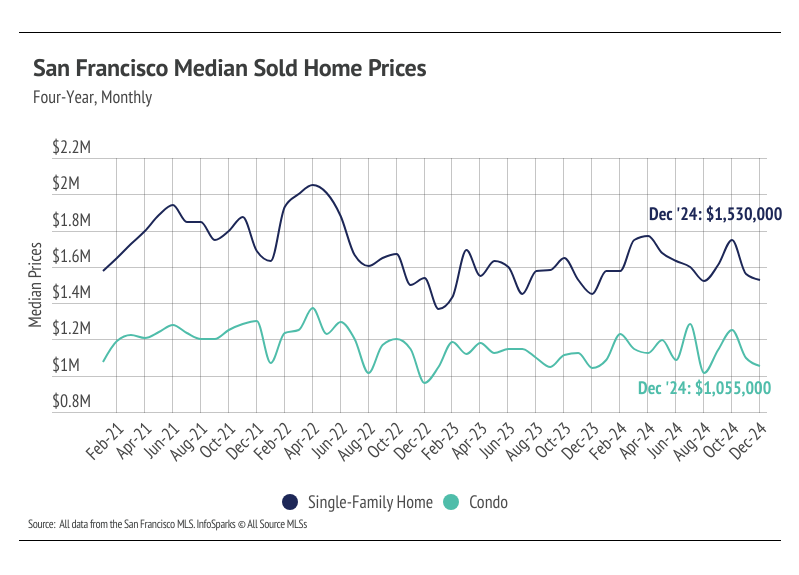
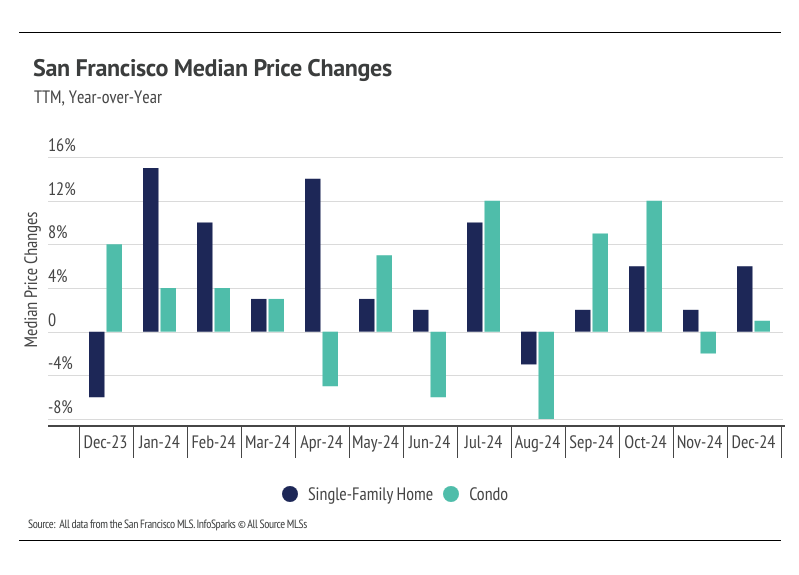
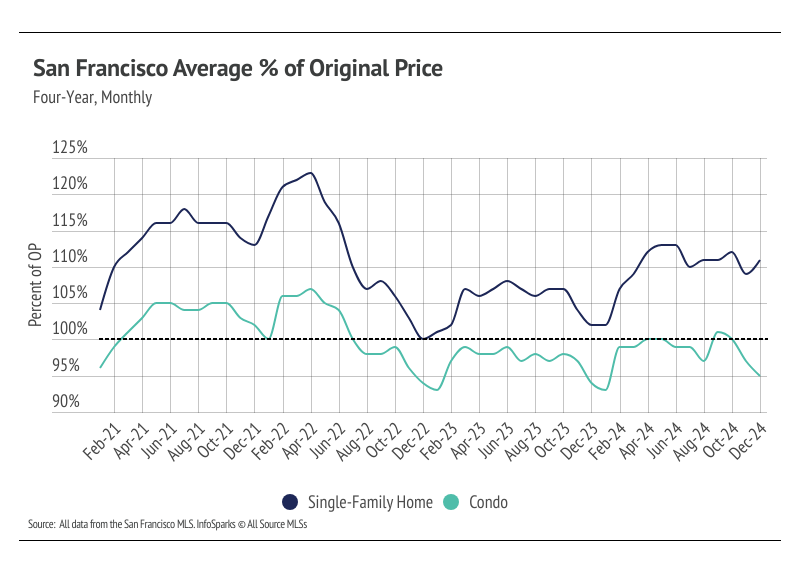
In San Francisco, home prices haven’t been largely affected by rising mortgage rates after the initial period of price correction from April 2022 to August 2022. Single-family home prices peaked at $2.05 million in April 2022 as mortgage rates rose rapidly; $2 million homes are simply far more affordable with a 4-5% mortgage than a 6-7% mortgage. Because of the relatively high prices of homes in San Francisco, prices had to come down to keep buyers in the market. Since August 2022, the median single-family home and condo prices have hovered around $1.6 million and $1.1 million, respectively. In December, prices were almost exactly in line with those averages. Year over year, the median price was up 5% for single-family homes, but down 1% for condos. Inventory is once again at a record low, so rising supply only increases prices as buyers are better able to find the best match.
 
High mortgage rates soften both supply and demand, but homebuyers and sellers seemed to tolerate rates near 6% much more than around 7%. Mortgage rates fell significantly from May through September, but rose significantly in the fourth quarter of 2024. Now, rates are far closer to 7% than 6%, so we expect sales to slow further.
 

Sales far outpaced new listings in December, dropping inventory to all-time lows

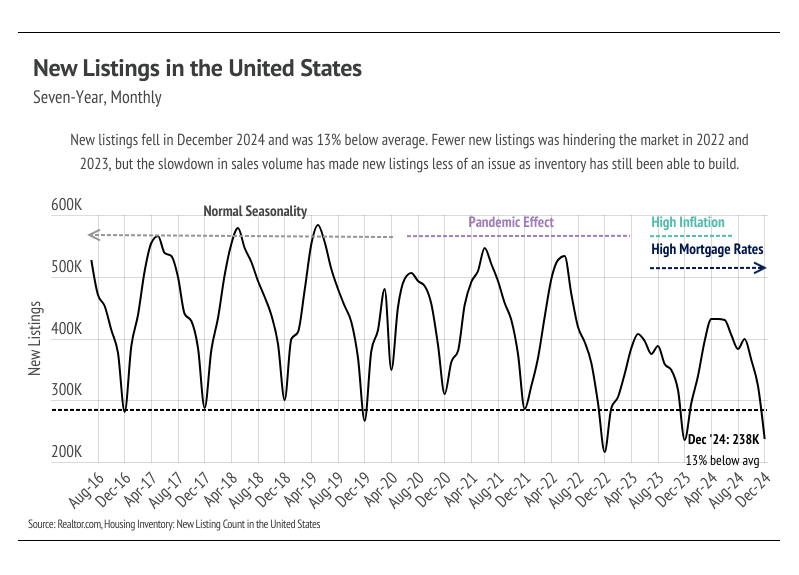
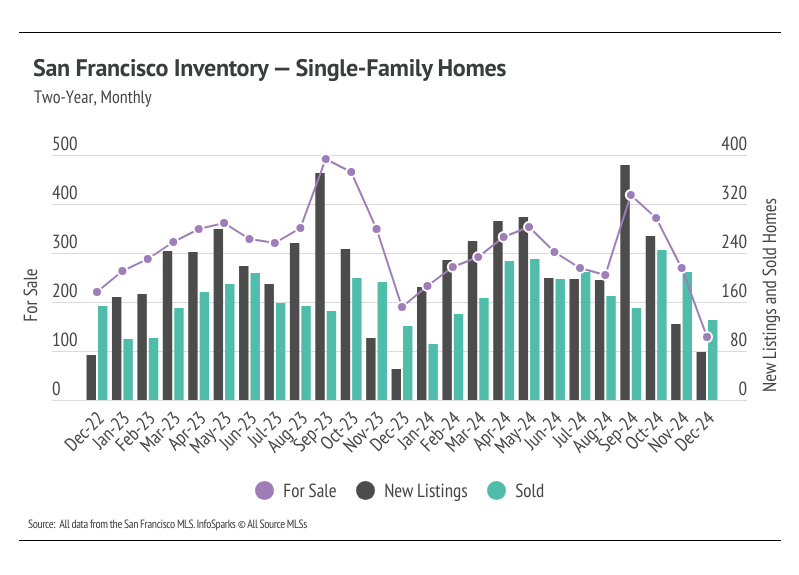
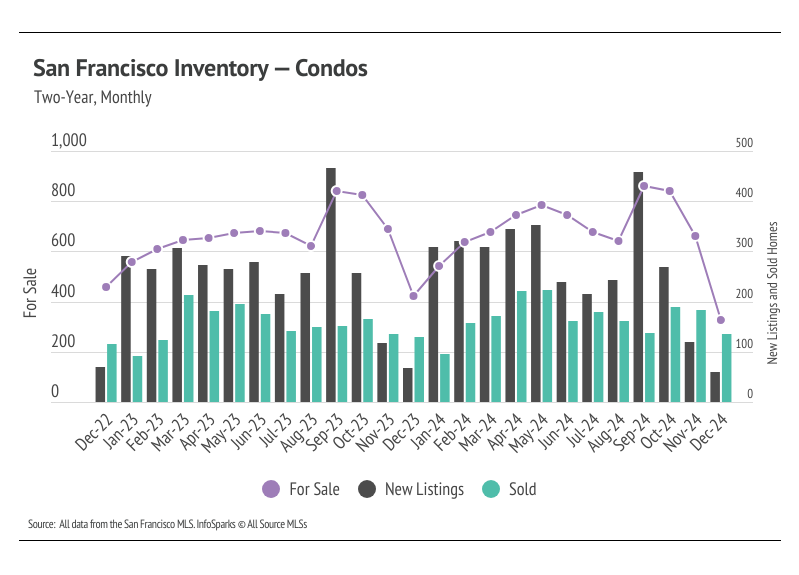
Total inventory has trended lower essentially since 2010, but active listings fell precipitously from October 2020 to December 2021, as sales outpaced new listings, before stabilizing to a degree from January 2022 to the present at a depressed level. New listings are simply not coming to market, and sales have more than offset any new listings. Low inventory and new listings, coupled with high mortgage rates, have led to a substantial drop in sales and a generally slower housing market. Typically, inventory begins to increase in January or February, peaking in July or August before declining once again from the summer months to the winter. In 2023, sales didn’t resemble the typical seasonal inventory peaks and valleys. It’s looking like 2024 inventory, sales, and new listings will follow historically seasonal patterns, albeit at a depressed level. Supply will remain tight until spring 2025 at the earliest.
 
In December, sales far outpaced new listings, causing inventory to decline by 51%. Compared to last year, however, new listings are up 16%, which contributed to the year-over-year increase in sales, up 8%.
 

Months of Supply Inventory in December 2024 indicated a sellers’ market

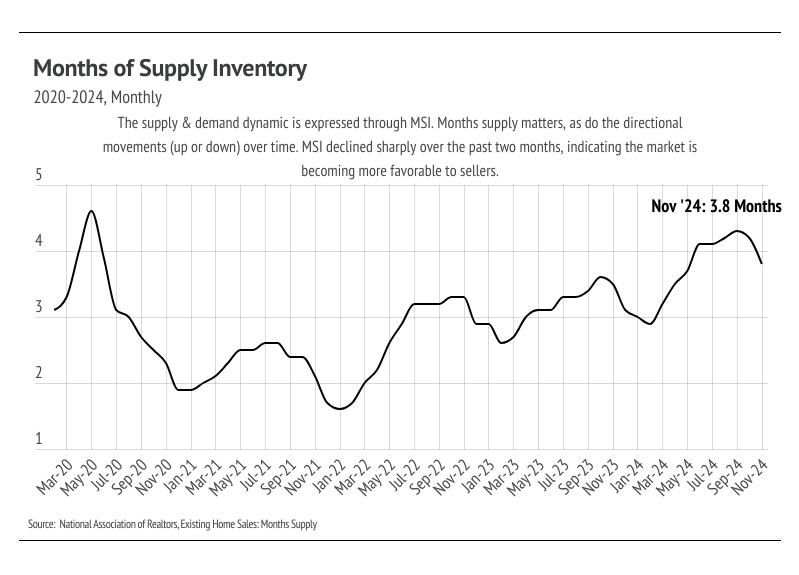
Months of Supply Inventory (MSI) quantifies the supply/demand relationship by measuring how many months it would take for all current homes listed on the market to sell at the current rate of sales. The long-term average MSI is around three months in California, which indicates a balanced market. An MSI lower than three indicates that there are more buyers than sellers on the market (meaning it’s a sellers’ market), while a higher MSI indicates there are more sellers than buyers (meaning it’s a buyers’ market). The San Francisco housing market tends to favor sellers, which is reflected in its low MSI, at least for single-family homes. MSI has been below three months since October 2023 for single-family homes. From May to August, MSI declined meaningfully. In September, MSI jumped higher as new listings spiked. However, in Q4, sales outpaced new listings and inventory dropped, which in turn caused MSI to fall. The current market strongly favors sellers.
 

Local Lowdown Data


Recent Blog Posts

Stay up to date on the latest real estate trends.

San Francisco Market Update - July 2026

Single-family home prices have surged more than 26% year-over-year, marking the strongest annual gain we've seen this year.

East Bay Market Update - July 2026

Prices are rising across the board, with the condo market posting its strongest year-over-year gains in years.

Education

Is Title Insurance Worth the Cost?

In many cases, the insurance proceeds received from a covered claim far exceeds the cost of the one-time premium paid for an owner’s policy of title insurance.

Elevation Real Estate Welcomes David Hiller to Our Team!

David's East Bay experience, creativity, and dedication to his clients made him a perfect fit for Elevation Real Estate

San Francisco Market Update - June 2026

San Francisco's single-family home market continues to reach new heights, with the median sale price climbing 22.56% year-over-year to $2,200,000. This marks one of th… Read more

East Bay Market Update - June 2026

Prices are on the rise across the board, with single-family homes and condos both posting year-over-year gains for the first time in over a year.

SF Market Update - May 2026

Median sale prices continue their remarkable ascent, with single-family homes up more than 21% and condos up more than 18% year-over-year.

East Bay Market Update - May 2026

After several months of relative stability, single-family home prices in the East Bay showed some softening in April.

Community Event - Please Join Us!

May 9th | 10AM - 1PM | 4 Norwich Street, San Francisco

Let’s Talk

You’ve got questions and we can’t wait to answer them.